By Dr. Kanika Tomalin | President and CEO, Foundation for a Healthy St. Petersburg
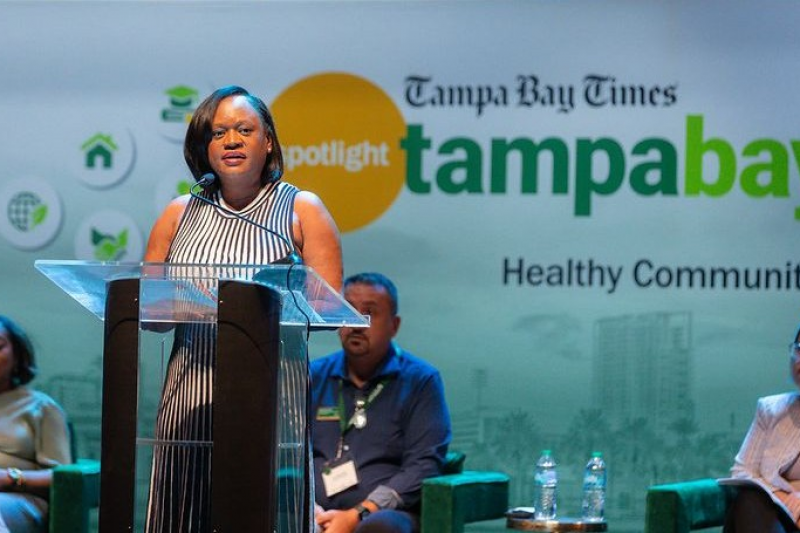
The following column is based on remarks by Dr. Kanika Tomalin at September’s Spotlight Tampa Bay: How AI Can Strengthen Our Communities event.
The last column I wrote in college, just about 30 years ago, was crafted with ingenue amazement about a technological advance that I was certain would revolutionize correspondence: Email!
All of the students on campus had just received fancy, kind of cryptic electronic mail addresses from the university. They were assigned: Kanikajelks@FAMU.edu. Administration, knowing us, warned us: keep track of this new handle. You’ll need it. It was how we would receive most of our information from the school in the future …where’d we’d be notified of tuition bills and overdue books, feedback from professors and unpaid parking tickets. We could also use it for personal correspondence, they offered.
As if I would use email for personal correspondence, I thought…
But, the school was insistent and enthusiastic, encouraging us to trade in our calling-card funded long-distance calls for this quick-click way to keep in touch. Our parents, friends, future jobs could all reach us at this address they said…and with the click of a button that read “send” we were propelled into the future, Jetsons style. It was the dawn of a new era, previewed by the world wide web, made more popular for the innovators among us through this ever-growing platform called AOL. All of a sudden, the page turned and all at once we heard: “You’ve got mail.”
Now it seems like a minor advancement… but, at the time it was a big deal. It was a completely new paradigm, almost more than I could imagine.
Fast forward three decades to a world whose college graduates may have never penned a letter on paper, much less dropped it in the mail. All they’ve ever known is email. We carry the Internet around in our pockets and access the whole world from the palms of our hands. Email? Try AI Conan Gallaty introducing last month’s Spotlight Tampa Bay lecture. We’ve skipped paradigms and entered a whole new world. The promise of artificial intelligence, once intellectual fodder reserved for PBS watchers and readers of Scientific American, is a reality that informs our everyday lives – whether we like it or not, whether we know it or not, whether we understand it or not.
AI is here: authoring research papers and reading radiology reports. Its power is palpable and its place in our world, nation, and community is beyond debate. As we find ourselves in the last days of negotiation around what AI will mean for our world, now is the time to determine and define how we will harness its power in ways that empower our community and aid our agency.
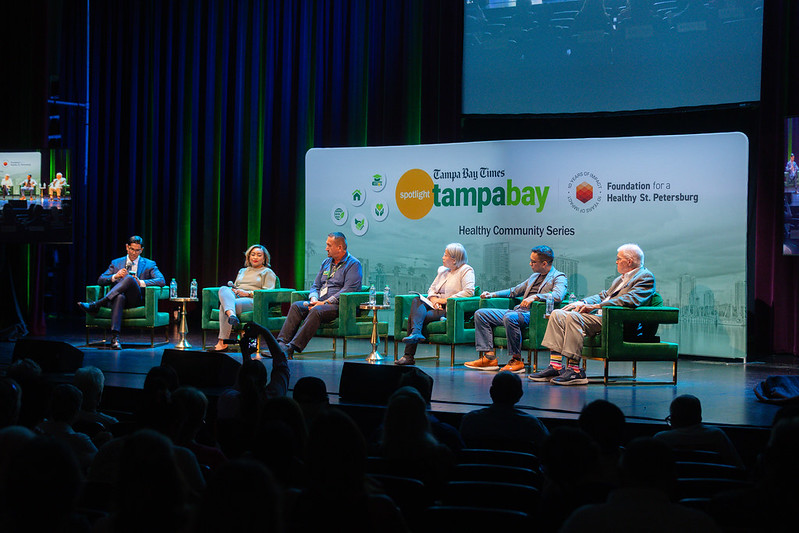
Alex Mahadevan, Director of MediaWise at The Poynter Institute, moderates a panel with Dr. John Licato, Martika B. Jones, and Dr. Zafer Unal. Vivian Sun and Michael O. Bice
As President and CEO of the Foundation for a Healthy St. Petersburg, which works to eradicate health and social disparities in our community, I think about empowerment and agency every day. Our vision to help create a community where good health allows all people to thrive requires our people to have both. The ways in which AI boosts or burdens empowerment and agency is a principal concern and, like you, we are excited about what Spotlight Tampa Bay: How AI Can Strengthen Our Communities can collectively teach us.
At the end of September, a panel of local experts gathered to speak to members of the public about how we can use artificial intelligence to help build a healthier, stronger, more resilient community, as well as what it can and will do in our individual lives.
Whether you’ve been anticipating AI’s arrival with unbridled enthusiasm or anxious trepidation, it is all around us. And its influence is only poised to grow. The opportunity before us now, as we march through the dawn of this new age is to decide and commit, that in our community, in all the ways we can, we will harness its power for the collective good.
AI is a tool. Invented by people, informed by people, defined by people. It has tremendous power to educate, assist, and discover – at speeds that exceed our human capacity. It has the potential to create jobs, engineer opportunities, and meet the complexity of vexing problems with equally complex solutions. It has exponential ability to boost the efficiency and efficacy of almost every human task.
But, it also has the power and potential to harm and to obfuscate. Left unchecked, AI can disserve in ways that reinforce bias with no basis, eliminates jobs with no alternatives, to serve as a substitute instead of a supplement to the roles humans hold in society.
AI’s ability and likelihood to help or harm will, in large measure, depend on the rules and uses we set for it now in our society – and, how we provide parameters on those standards in our community.
This leads us to September’s Spotlight Tampa Bay conversation. As we move together as a community to make plans for AI’s use, we must do so with all of our community members in mind – especially the most vulnerable and those history shows us are most likely to be under-served. Our thoughts and planning around this hefty topic must be rooted in a commitment to equity and ethics… in keeping with our community’s values… and as is required for the region’s continued strength, resilience, and health.
As we at the Foundation for a Healthy St. Pete lead, fund, partner, and advocate, we honor our role as conveners in the continuum of change that guides our community forward. We all have a role to play in our commitment to our community, and we were proud to partner with the Tampa Bay Times to host last week’s engagement. We hope it left you with increased agency and empowerment – because both are required if we are to be a place that takes good care of everyone who calls it home.
Thank you for what you do in that regard, and may September’s program help you do it: whether you’re contributing ideas, or spreading them… bringing resources to the table, or people… whether you’re asking questions, answering them… being a champion for change or opening a door to deeper partnerships. You are making a difference.
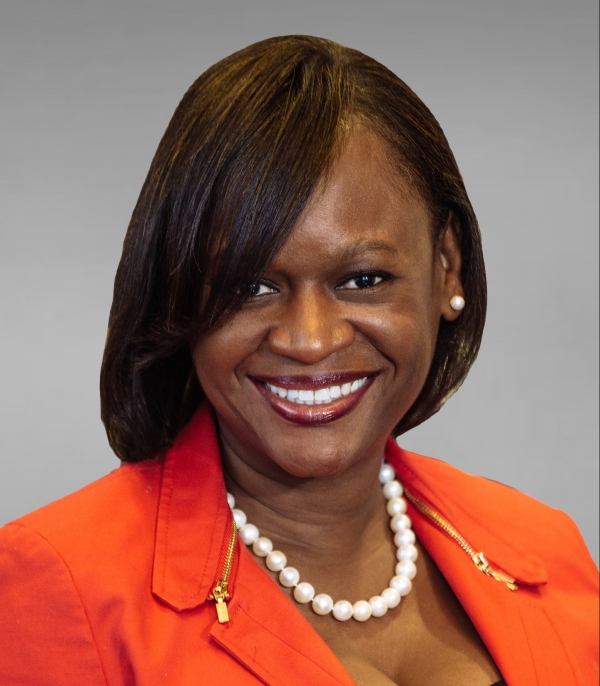 Dr. Kanika Tomalin is the President and Chief Executive Officer of the Foundation for a Healthy St. Petersburg. In this role, she leads, directs, and integrates all aspects of the Foundation’s internal and external activities and initiatives. Working closely with the Foundation team, Dr. Tomalin creates and executes the Foundation’s strategic plan—overseeing grantmaking, strategic initiatives, and the Center for Health Equity. She guides the organization as a steward of the community’s resources, consistently reporting back to the community and ensuring decisions and plans of action are mission-aligned and based in equity.