By Geveryl Robinson | Contributor
Anger.
That’s what I felt when I heard about the Supreme Court’s 6–3 decision in Louisiana v. Callais: a decision that, in plain terms, weakens one of the last protections under Section 2 of the Voting Rights Act and opens the door for states to draw maps that dilute the voices of Black voters and other communities that have long been pushed to the margins. Because make no mistake, other groups will feel the sting of this decision, one that will affect us all.
For those who may not know the backstory or the significance of this decision, the Voting Rights Act of 1965 was passed shortly after “Bloody Sunday.” Led by the late John Lewis and Hosea Williams, the assault involved around 600 peaceful voting rights marchers who were marching to demand voting rights for Black people in Selma, AL, who were violently attacked with clubs, whips, and tear gas by Alabama state troopers and deputies.
Yeah, that’s right; the police, law enforcement attacked peaceful citizens who just wanted equal access at the ballot box, free from poll taxes or voting fees, literacy tests, and other unfair voting practices. The outrage from the public who witnessed the televised brutal beatings led to action. On August 6, 1965, President Lyndon B. Johnson signed the Voting Rights Act into law.
Then, on April 29, 2026, the Supreme Court snatched those rights back.
I’m angry.
But I’m not just angry at the Supreme Court.
I’m angry at the registered voters who decided the last election wasn’t important enough to show up for. Apathy is a hell of a drug. It numbs you. It convinces you that nothing will change whether you participate or not, and in 2024, too many people sat out. Too many people ignored what was right in front of them. Too many people knew the consequences and didn’t care.
I’m angry at those who were uncommitted to anything that didn’t focus on the one issue that was most important to them, to the detriment of everyone else. I’m angry at those who basically use “both sides are the same” to take us back to Jim Crow, and don’t even get me started about the 2016 election.
But, most of all, I’m angry that this country didn’t care enough to protect what everyone who just wanted the right to vote fought for. But then, maybe I was naïve to think they would.
‘Cause real talk, at the end of the day, the truth we don’t always want to say aloud is this: the only people who have consistently cared about Black people are Black people. What’s even sadder is that if I’m being honest, sometimes some of us don’t care about us either. #ClarenceThomas
So now, 61 years after the Voting Rights Act of 1965, here we are in 2026 watching the clock get turned back. As I’m typing this, I’m thinking about my 92-year-old mother. I’m thinking about my aunts in their 90s and late 80s. I’m thinking about the people who marched, who were beaten, who were jailed, who died for the right to vote, and I am incensed.
Because the Louisiana v. Callais decision isn’t about maps. Decisions like this never are. No, this decision is about one thing…
Power.
It’s about who gets to shape the future and who gets pushed to the margins. It’s about whether communities that show up, organize, and vote actually get to see that power reflected or whether it gets carved up, diluted, and redirected.
When communities are split apart or packed into as few districts as possible, the Court and legislators are not just drawing lines; they’re deciding whose voices matter and whose don’t. And make no mistake, this system has always been determined to bend us, to weaken us, and to break us.
But it keeps failing.
Because no matter what they throw at us, WE ARE STILL HERE! And yes, I am yelling!
We’re still organizing.
We’re still building.
We’re still showing up.
Our power is real. That’s why it’s targeted.
Our strength is undeniable. That’s why it’s feared.
Our very existence in spaces where we were never meant to have influence makes people uncomfortable.
Oh, and our vote?
You already know: our vote is our voice, and our collective voices move mountains. Decisions like this send a very clear message: they don’t want our votes because they are afraid that they will be sitting on top of the next mountains that we move.
But here’s the part that the powers that be keep forgetting: no matter how hard they try to silence our votes and our voices, for generations and generations, we’ve answered the same way: we strategize, we mobilize, and we refuse to disappear.
See, the truth is they’re redrawing the lines, not because we’re weak, but because they are. They fear our strength. They fear our power. They fear us because they can’t stop us.
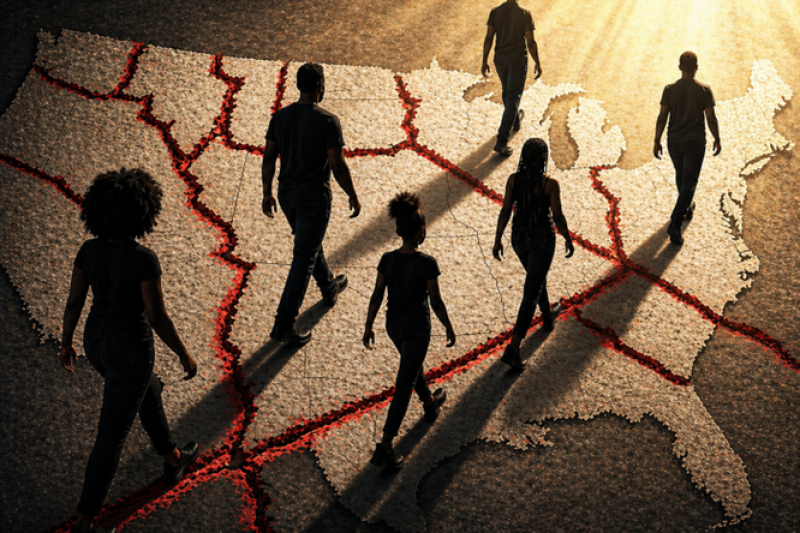
So let them go ahead and redraw the maps.
Then let’s remind them of who we are.
Let’s cross every line they redraw.