The Obamas and the Inauguration of Black Painting’s New Golden Age In America
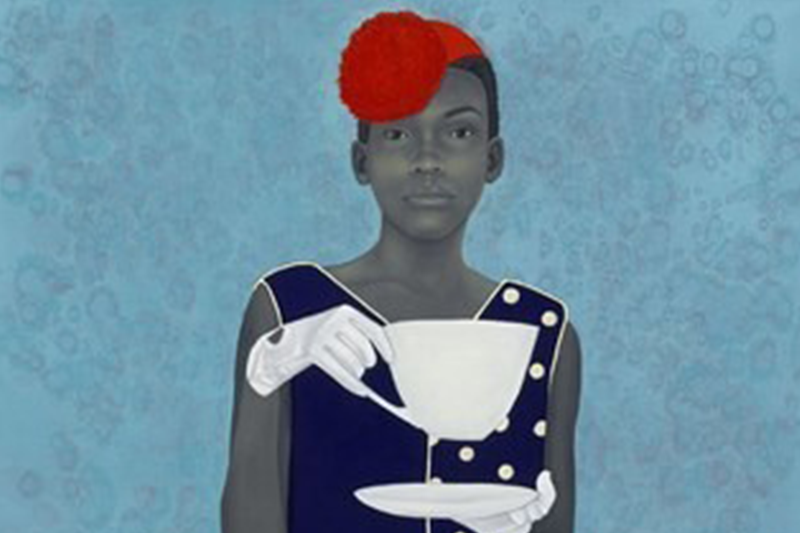

 “I’m my own ideal,” Sherald said when I asked why she grayed a black body as a point of departure. “There’s a contemporary black narrative lacking because there’s a narrative that I am living that I don’t see when I walk into museums. I wanted to see these stories, so for me it was important to fill the narrative up with images that looked like the stories that I was living.” She added, “Just because someone said painting is dead doesn’t mean that it’s a fact or the truth—painting is the soul food of art, in a way.”
 The first time those words were uttered was probably around 1839, when the French history painter Paul Delaroche encountered a daguerrotype and reportedly made the declaration. And it’s not hard to see what he meant: Why labor over a painting if you could simply take a picture? In nearly every decade since, every new advancement of expression in art has asked the same question of painting: Marcel Duchamp and the Dadaists in the early 1900s, the conceptualists of the 60’s, and others have all rejected traditional artmaking practices under the guise that that those modes had already expressed all they could about life.
 The people painter Barkley L. Hendricks, who died in April, also rose to prominence in the late 60’s, and mostly rejected the idea that it was the black artist’s job to make affirming images of black folks in order to counteract Western visual culture’s historic white supremacy. In works like Woody, a 1973 oil of a dark-skinned black male captured in the middle of a dance pose wearing a yellow leotard against a similarly-colored backdrop, he painted black folks as he saw them—not as symbols of power or protest but as they really were, in life. (A tribute of 11 works organized by the curator Trevor Schoonmaker will be presented later this month during the New Orleans triennial Prospect.4.) Influenced by Old Masters, American realism, and the hood alike, Hendricks’s art gained traction briefly before falling out of vogue like many of the black artists working in the 60’s and 70’s. Amy Sherald, for example, had not heard of Barkley L. Hendricks or Kerry James Marshall until after she’d completed her MFA in painting in 2004. “I didn’t have any artists who painted the figure to look at when I was growing up,” she said.
 “I paint the black male figure because it’s mine,” explained the artist Jeff Sonhouse, 49. “That’s who I am.” In his painting Witness Protection Program, an oil depicting a geometrically-camouflaged black male figure, and other works in his current solo show at Tilton Gallery in New York, there’s a sense of what he calls “friction,” because the black figure is obscured rather than really visible to the viewer. “I’m not motivated by a sense of being seen,” he said. “I really don’t give a damn if I’m included or have been omitted in some sense.” This echoed a conversation I had with Hendricks before his death. “What moves me,” Sonhouse went on, “is making damn good work.”
 None of this is to say that abstraction has nothing to do with this moment in black painting—artists like Jennifer Packer, Tschabalala Self, Derrick Adams, and the 77-year-old icon Jack Whitten are just using it in exciting ways that elevate and complicate the identity of the black figure and its place in the world shown in the painting. (Even Mark Bradford, a painter of pure abstraction who represented the U.S. at the 2017 Venice Biennale, references the social condition of the black body.) “When I think of the figure, I think of immortality or an otherness that is just out of this world, representing an endless possibility,” the British-Ghanian artist Lynette Yiadom-Boakye told me of the fictive black people in her recent New Museum exhibition. Yiadom-Boakye’s figures, seen in works like Mercy Over Matter, an oil of a black man comprised of many bursts of orange, green, blue, and black, exist in what Amy Sherald described to me as a “luminal space.”
 When Kehinde Wiley first encountered Kerry James Marshall’s De Style, a painted scene of a barbershop, at LACMA in the 90’s, it changed his mind about what stories can be told about black lives in painting. “It made me feel as though the walls of the institution were accessible and permeable, rather than alienating,” he told me in a recent interview for the magazine Hello Mr.With portraits like 2008’s Morpheus, of a black man reclining in a sea of flowers, wearing a baseball cap, tank top, blue jeans, sneakers, and a gold chain around his neck, Wiley has made the canvas—and the gallery and museum walls where they’re hung—a place to encounter ordinary black folks. “When I got to New York, I was thrust into the Harlem of pre-9/11 America, where people were parading around 125th Street,” he recalled. “I wanted to wrap my practice around that.”
Wilbur, 100 years young PINELLAS COUNTY – Beth Reynolds, director of…
BY JOYCE NANETTE JOHNSON, Staff Writer ST. PETERSBURG – Shawn Brown, nationally…
Local musical artist Siobhan Monique Roland will release her new album at the Motherland…