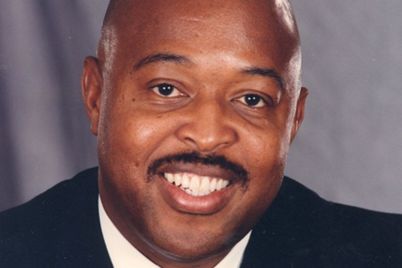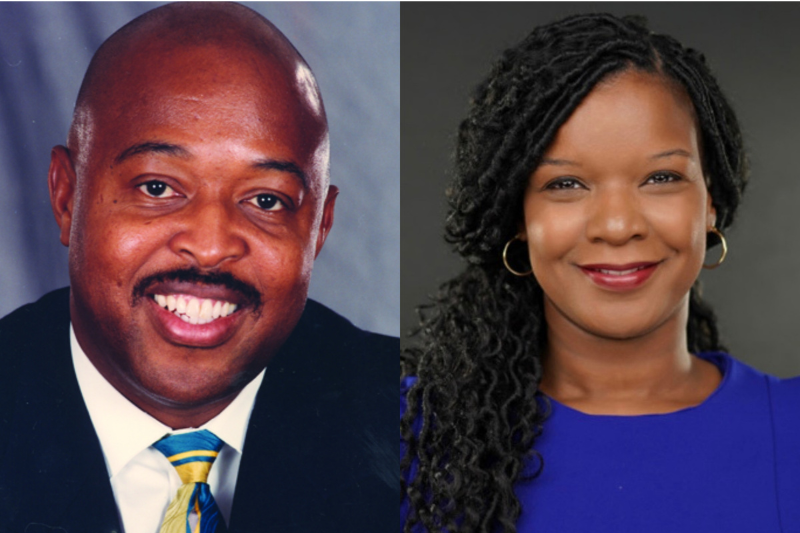
‘Mrs. Edmond, your approach must change. Ghost writing is not sufficient,’ said Dr. Goliath Davis. Caprice Edmond (right) was elected School Board Chair earlier this month.
GOLIATH J. DAVIS, III, Ph.D. | Contributor
PINELLAS COUNTY — All of us have heard the expression, “better late than never,” and never has it been more appropriate than now. School Board member Caprice Edmond, elected as chairperson on Nov. 11 of this year, has been a silent voice in the community that elected her in 2020. There has been a host of critical education issues over the last five years, and Ms. Edmond’s voice has been nonexistent. Now that the school board has elected her as chair, she mysteriously decides to emerge as a ghostwriter for the district.
Admittedly, the article she agreed to place her name on addresses an important issue. But it is obvious the district’s communications department had a hand in framing the issue, the layout, and the overall message. However, the message lacks essential context, and the method used to communicate and disseminate it needs to be expanded.
While it’s true that the declining birth rates and affordability have contributed to a decline in school enrollment in Pinellas, the state’s political climate cannot be overlooked. The conservative governmental environment has led to an exodus of individuals and families from the Sunshine State. Book banning, restrictions on teaching American history, and the abolition of DEI continue to have adverse consequences for the state. Florida State Statute 1002.333, enacted in 2017, and Senate Bill 2510, passed this year, are critical to the use of public school facilities and the future of public education.
Both the statute and the Senate bill have significantly improved charter schools’ ability to grow and flourish on the public’s dime. “Schools of Hope” are the educational institutions born from the legislation. They are typically charter schools that were initially given permission to occupy vacant school structures in underperforming areas and, with the passage of SB2510, are now allowed to co-locate in underutilized or vacant spaces within a school. In addition to the public dollars the state provides to charters, school districts are required to pay for utilities, maintenance, and food for scholars.
Jessie Mendoza recently reported in “Florida Politics” that Charter Schools are submitting documents claiming 25,000 spaces across more than 50 campuses in Pinellas County. Specifically, 1,341 seats are requested at Boca Ciega High School, two requests for Lealman Innovation Academy (769/815), two requests for Bay Point Middle (679/770),685 claims for seats at John Hopkins Middle School, and an assortment of claims for the following elementary schools: Gulfport, Bear Creek, Kings Highway, and Sandy Lane.
So, when explained in the larger context, there is no doubt that this is a big deal being sold as an improvement for students attending low-performing schools. However, one must not forget that charters cherry-pick and cream. In other words, there is no guarantee that the average Black scholar will be granted admission. Equity and inclusion also become issues, as well as parental access and participation.
The meeting at Boca Ciega High School referenced by Edmond was not well attended, given the magnitude of the problem. I predict others will not be well attended either if the way they are advertised is not improved. Engaged parents report never receiving meeting notices and suggest Edmond is merely checking the box for the district with her article. In other words, they doubt the district’s sincerity about wanting community input. Some believe the district has already made decisions in some cases and is finalizing others in preparation for the legislative mandate and budget reductions.
I fully understand the issue of declining enrollment. State funding is awarded in part based on the number of students enrolled, and as the census declines, so do the funds. Mrs. Edmond, your approach must change. Ghost writing is not sufficient. The masses do not know you. You have failed to lead! Discussions must be genuine, and you must do more to get the parents out to the meetings. The message and the approach must be decentralized. School leaders must advise parents and document their recommendations. But, to do so, the district must trust the school administrators and provide the appropriate training.
Parents and scholars alike must be asking: How will the changes affect my school? Will my school close? Will we lose course offerings and programs? How do I select my child’s middle, high, or choice school if I do not know its future status? Just to name a few.
Mrs. Edmond, please note that stakeholder surveys are insufficient for this issue. People do not fully understand the problem. Your typical “listen and learn” format will not work for such a critical issue either. Like it or not, it is time to get with the people and answer some hard questions. You have coasted for five years, but as previously stated, better late than never. It is time to take the point and lead the way.
Dr. Goliath Davis, a former St. Petersburg police chief and deputy mayor, advocates for education in Pinellas County, with a focus on improving Black student achievement.